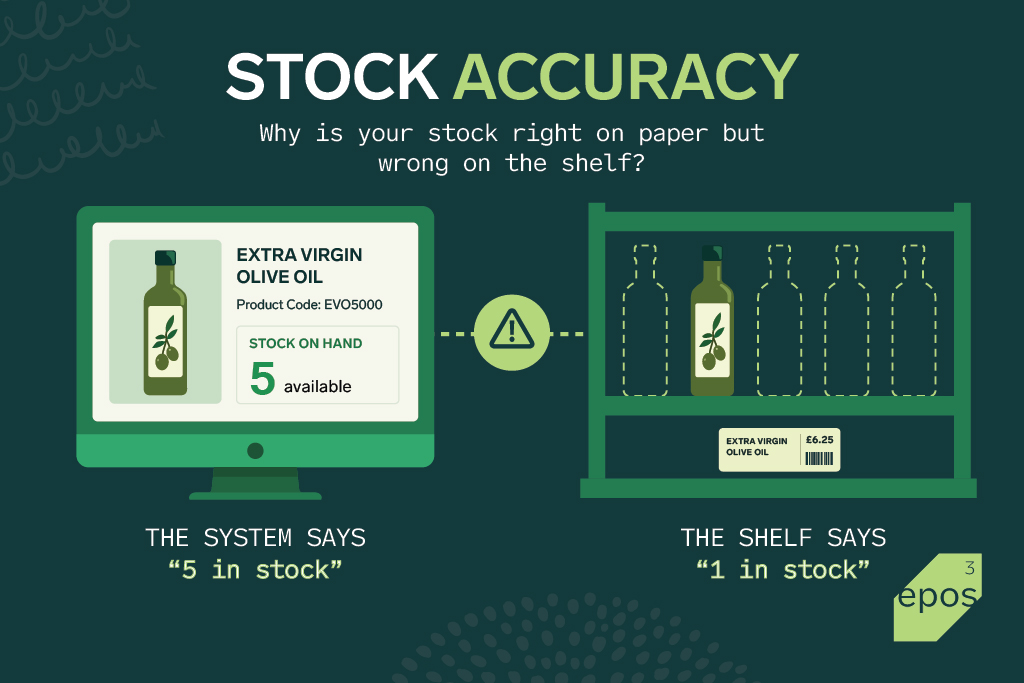
A customer asks for an item…
A member of staff checks the till, the back office, maybe even the website, and everything suggests it should be there. Someone walks to the shelf, checks the display, looks in the stockroom, asks a colleague, and eventually comes back with the answer nobody wants to give.
“I’m sorry, we don’t seem to have it.”
This is one of the most common problems in retail stock control. On ‘paper’, the stock file looks fine. In the real world, the item is missing, miscounted, misplaced, wasted, transferred, stolen, sold under the wrong code, or sitting in the wrong part of the building.
Stock accuracy is not just a software problem. It is an operational habit.
A good EPOS system can help enormously, but only when the stock processes around it are clear enough for people to follow during a normal working day.
What “wrong on the shelf” really means
When retailers talk about stock being wrong, they often mean one of several things.
Phantom stock
The system shows stock that does not physically exist, creating lost sales and disappointed customers.
Hidden stock
The system shows no stock, but the item is actually somewhere in the building or another branch.
Wrong location
The item exists, but not where staff expect it to be: stockroom, display, counter, seasonal area or customer order.
Unrecorded movement
The item was sold, damaged, wasted, transferred or returned, but the system was not updated properly.
All of these scenarios have the same effect. Staff stop trusting the system.
Once that happens, the system becomes less useful:
- People start double-checking everything manually.
- They walk the shop floor more often.
- They keep side notes.
- They create spreadsheets.
- They ask the same colleague who “usually knows”.
- They override the till.
- They adjust stock later, if they remember.
That is when stock control starts to go wrong.
Why this matters more than people sometimes realise
Stock accuracy is not admin for the sake of admin. It shapes availability, cash flow, margin, purchasing and customer confidence.
When stock is overstated
You may miss sales, disappoint customers and waste staff time searching for items that cannot be found.
When stock is understated
You may reorder unnecessarily, tie up cash and miss opportunities to sell items already in the business.
Distorted inventory figures are a major commercial issue right across retail. If the system says you have stock that you do not have, you may miss a sale. If it says you are out of stock when you are not, you may reorder unnecessarily.
In fresh food, the consequences can be even more immediate. Perishable products, waste, short shelf life and fast-changing demand can all make stock accuracy harder to maintain.
Regular stocktakes can help, and not just for ‘tidy-up’. Done properly, they can be a proactive sales and margin exercise.
Where stock accuracy usually breaks
Most stock problems do not come from one dramatic mistake. They come from lots of small events where the physical movement of stock and the digital record of stock no longer match.
1. Goods-in is rushed or inconsistent
Stock accuracy starts before an item reaches the shelf. If goods-in is not handled properly, the system is already wrong before the customer has even seen the product.
That can happen when deliveries are accepted quickly but not checked properly. Supplier paperwork may not match what actually arrived. Substitutions may be made. Pack sizes may differ. Damaged goods may be accepted without adjustment. Part deliveries may be booked as complete.
In a busy farm shop, garden centre or department store, goods-in is often happening at the same time as everything else. Staff are serving customers, answering phones, preparing counters, unloading vans and trying to keep the day moving forward.
That is when shortcuts happen: “I’ll book that in later.”
The problem, is that later is often too late…
2. Product records are messy
Stock accuracy depends on clean product data. If products are duplicated, mislabelled or created inconsistently, the till may be reducing the wrong item. The stock may be physically present, but the system is looking in the wrong place.
This is especially common where retailers have lots of similar products. A department store might have the same jumper in different sizes and colours. A garden centre might sell similar pots, composts, plants and seasonal lines from several suppliers. A farm shop might have products sold loose, pre-packed, weighed, made in-house or included in hampers.
Common issues include duplicate barcodes, products sold under ‘miscellaneous‘ buttons, incorrect departments, old products reused for new items, unclear variants, and product settings that do not match the way the item is actually sold.
3. Sales are not always linked to the right stock item
Every sale should reduce the correct stock item. That sounds obvious, but in real retail it is easy for the wrong thing to happen.
A member of staff may use an open department button instead of scanning the product. A similar item may be selected because it is easier to find. A barcode may not scan, so the sale is put through manually. A special offer may be set up in a way that enables the sale but does not adjust the stock properly.
In food retail and hospitality, this can become more complicated. A product may be sold as part of a recipe, bundle, hamper or meal deal. Ingredients may be used in the kitchen. Prepared products may be made from raw stock. Waste may happen before anything is sold.
4. Transfers happen physically, but not digitally
Stock does not always remain where it was first put. It moves from stockroom to shelf. From one department to another. One branch to another. Maybe from the shop to the café or from the counter to a customer order. From a main site to an event, pop-up or seasonal area.
In many businesses, those movements happen quickly and informally. Someone needs more stock on a display, so they take it. A branch is short, so another branch sends some over. A café borrows retail stock for a recipe.
The physical stock has moved, but unless the EPOS records that movement, the system still thinks the item is somewhere else.
5. Waste and damage are not recorded properly
Waste is uncomfortable because nobody enjoys recording loss. However, if waste is not recorded, the system still thinks the product exists.
In fresh food, waste might include out-of-date products, damaged packaging, spoiled produce, kitchen prep loss, unsold bakery items, counter wastage or products used internally. In garden centres, waste might include damaged plants, weather-affected stock, broken pots or seasonal stock that can no longer be sold at full value.
If these movements are not captured, the stock file becomes ‘optimistic‘.
It tells the business what it wishes it had, not what it actually has.
6. Returns are treated as an afterthought
A returned item may be resellable, damaged, incomplete, missing packaging, seasonal, faulty or already refunded but not physically returned to saleable stock.
If all returns are treated the same, stock can quickly become misleading. This is particularly important for department stores and lifestyle retailers, where size, colour and variant accuracy matters.
7. Theft and shrinkage change the numbers silently
Not every missing item is an admin error. Theft changes the physical stock position without creating a normal transaction. The system does not know something has gone missing until a count, investigation, or customer query reveals a difference.
🟩 EPOS alone cannot stop theft, but accurate stock processes help retailers see where numbers are repeatedly drifting.
8. Promotions and markdowns make the sales 'picture' harder to read
Promotions are useful, but they can complicate stock accuracy and demand planning. A multibuy may move stock faster than expected. A clearance offer may empty a line in a weekend. A markdown on fresh food may create a short-term sales lift that should not be mistaken for normal demand.
A product may look popular because it sold quickly at 30% off. That does not mean the business should reorder the same quantity at full margin.
9. Stocktakes are treated as a cure, not a habit
A stocktake can correct the numbers, but it does not explain why they were wrong. That is why businesses often complete a stocktake, feel better for a few weeks, and then find themselves back in the same position.
Annual stocktakes have their place, but they are not enough on their own. Cycle counts are usually more practical. Instead of counting everything at once, retailers can regularly count smaller groups of products, high-value items, fast-moving lines, problem departments or seasonal ranges.
How Storefront helps bring stock back in line with reality
The first step is: accepting that stock accuracy is a shared responsibility between people, process and software.
Storefront™ can help by giving retailers better tools for the places where stock accuracy usually starts to slip. That includes product records, goods-in, stock adjustments, stock takes, handheld workflows, branch visibility, transfers, reporting, recipes, waste and promotions.
Receive
Book in what actually arrived, not what everyone hoped had arrived.
Move
Record transfers between branches, departments and trading areas.
Sell
Reduce the right product when the customer buys it.
Count
Use regular counts to catch drift before it becomes normal.
Learn
Use reporting to understand where errors, waste or loss keep appearing.
For a farm shop or food hall, that might mean linking fresh food, counter products, recipes, waste and weighed items more closely to the stock position.
In a garden centre, it might mean managing seasonal stock, plant ranges, giftware, outdoor areas and café activity without losing visibility.
Within a department store, it might mean handling variants, departments, suppliers, branch stock and customer orders more consistently.
For a mixed retail and hospitality business, it might mean understanding how retail stock, kitchen use, recipes and finished products affect the wider operation.
A practical checklist for better stock accuracy
Retailers who want better stock accuracy should start with the basics.
Clean up product data. Make sure products, barcodes, variants, departments and supplier details are consistent.
Tighten goods-in. Receive stock properly before it moves into the business.
Use handhelds where they help. Stock takes, goods-in and checks are easier where the stock physically is.
Record transfers at the time they happen. Stock moved between branches, departments or trading areas should move in the system too.
Capture waste and damage. If something cannot be sold, the system needs to know.
Review returns properly. Decide whether returned items are saleable, damaged, held, written off or moved elsewhere.
Count little and often. Use cycle counts for high-risk, high-value, fast-moving or frequently inaccurate products.
Watch exceptions. Repeated negative stock, regular adjustments or unusual gaps can point to bigger process issues.
Train staff on the reason, not just the button. People are more likely to follow a stock process when they understand what it protects.
The real answer: Make reality easier to record
Most retailers do not have inaccurate stock because they are careless.
They have inaccurate stock because retail is busy:
- Deliveries arrive when customers need serving.
- Products move quickly.
- Staff make decisions in the moment.
- Waste happens.
- Returns pile up.
- Seasonal ranges change.
- A café borrows stock.
- A branch needs help.
- A product gets put in the wrong place.
- A barcode does not scan.
- Someone means to fix it later.
Then the system and the shelf slowly move apart.
The answer is not to blame the team. The answer is to make the reality of retail easier to record.
Not as a one-off clean-up, but as a better way of running your business every day.
When goods-in, transfers, stock takes, waste, returns and product records are easier to manage, the system becomes more trustworthy. When the system becomes more trustworthy, staff use it with more confidence, and when staff are more confident, managers get better information.
It’s at this point that stock control starts to improve, and your EPOS systems can start to serve you better.
Storefront™ helps retailers manage product records, goods-in, transfers, stock takes, waste and reporting from one connected EPOS platform.
If you would like more information, we’d be happy to show you a different approach to retail systems.
Simply click the button below, and we’ll get in touch to find out more about your current challenges and arrange a demo.